Air Sealing in Mississauga, ON
Air sealing for Mississauga attics at the pot lights, plumbing stacks and attic hatch. We do it from the attic side, before more insulation goes on.
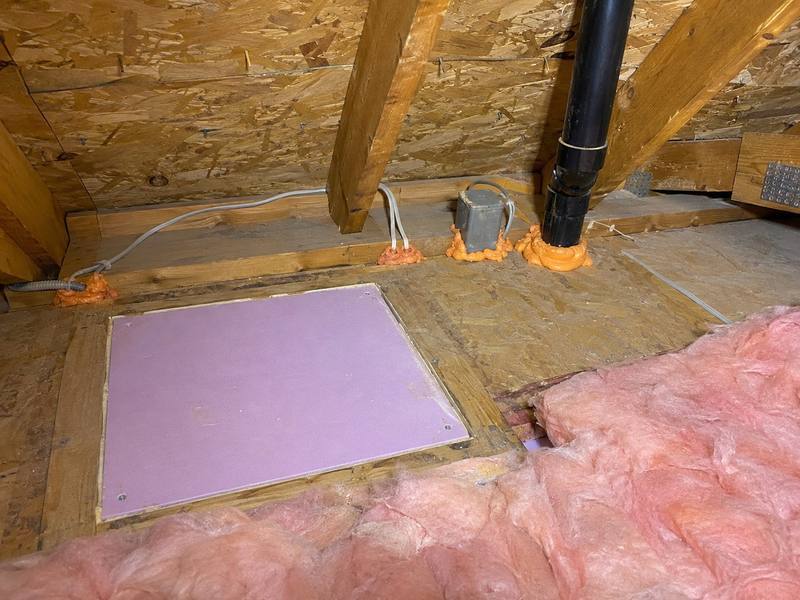
Air sealing in Mississauga is the work of closing the gaps where house air rises into the attic. Before a top-up we seal three spots from the attic side: the pot lights, the plumbing stacks and the attic hatch. It makes sense if you are planning more attic insulation, or if you feel a draft at a ceiling light or around the hatch.
Pot lights
Older pot lights can leak warm house air straight into the attic. An older recessed housing may have vents or open seams, and the hole in the ceiling is sometimes cut wider than the trim covers. Before Platinum Insulation Contractors of Mississauga adds any insulation, we find each pot light from above and check what kind of housing it has.
If an older fixture still works, we would fit a cover box. It stays on our side of the ceiling, nothing electrical changes, and nobody touches the room below. If the light is failing or you plan to replace it anyway, a new fixture makes more sense, and an electrician installs it before we arrive. Either way the job ends the same, with the gap at the ceiling closed.
Here are the two options for a pot light:
- Cover box from the attic side: we set a box over the light and seal its base to the ceiling drywall with foam or caulk. The box stops the air and holds insulation back from the fixture, so the light keeps its own air space.
- New fixture built for insulation contact: the old housing comes out and a fixture built for direct contact with insulation goes in. An electrician does that part, not us, and it means work from the room below. Once it is in, we seal the ceiling gap around it and insulation can go right over the top.
Plumbing stacks and wiring holes
Every pipe and cable that runs up into the attic passes through the top plates, the flat framing along the top of each wall. Where the hole was drilled bigger than the pipe or cable, air from inside the wall cavity rises through it into the attic. A wall with a lot of wiring holes can move more air than a few small gaps would suggest.
Plumbing stacks take a little more thought. A stack can shift slightly as it warms and cools, and a stiff seal will crack and pull away from it over time. So the seal at a stack has to give.
Chimneys and flues are not ours to seal. They run hot and need clearances and materials that belong to a chimney or heating contractor. If we see a gap there, we point it out and leave it for that trade.
What we use depends on how big the gap is:
- Caulk for small gaps: a narrow ring around a cable or a thin crack along a top plate gets a bead of caulk.
- Foam for wider gaps: low-expansion spray foam fills a larger hole around a pipe or a cluster of wiring holes and sets there.
- A flexible seal at the stack: where the stack moves with temperature, we use a sealant that stays flexible, so it moves with the pipe rather than tearing off it.
The attic hatch
Insulating the attic hatch starts with a plain fact: a hatch is a hole in the ceiling with a loose lid sitting on a ledge. Air slips around the edges of the lid, and if the lid is a bare piece of drywall, there is almost nothing on it to slow heat.
For a hatch in a hallway or closet ceiling that you rarely open, we would go with weatherstrip and a foam board, because the lid stays light and easy to lift. A hatch you open more often suits an insulated cover box, and so does one where the new insulation will sit higher than the lid, since the box holds the loose fill back. Both options deal with the hatch only. House doors and windows are a separate job for a different trade.
Two ways to close up a hatch:
- Weatherstrip and foam board: weatherstrip goes on the ledge so the lid presses down onto a seal, and a foam board glued to the top of the lid insulates it. The hatch looks and opens much as it did before.
- Insulated cover box: a foam board box sits over the opening on the attic side, sealed at its base, with a lid that lifts off. It needs some headroom above the hatch and more material to build, and that material is what drives its price. In return, blown fibreglass stays put instead of spilling down when you open the hatch.
Why it comes before the top-up
Insulation slows heat, but air goes straight through it. Blown fibreglass over an open gap behaves like a furnace filter: warm, moist house air keeps rising through it into the cold attic.
Sealing an attic floor is easiest while the floor is bare or the old layer is thin, because every top plate, stack and pot light is in plain view and within reach. With the gaps closed, the attic top-ups go on over them, blown fibreglass laid to the depth markers we set across the attic.
If we find vermiculite, the tape measure goes back in the pocket. We leave it exactly as it is, and we recommend you have a qualified lab or abatement firm test it before any work goes ahead. We do not sample it, test it, move it or arrange that test ourselves.
Rebates and air sealing
Home Renovation Savings lists air sealing among the upgrades in its path that needs a home energy assessment. We do not do, book or arrange that assessment, so you would set it up with an assessor yourself.
What qualifies and what paperwork the programme wants depends on its current terms, so check them before work starts. Our insulation rebates page covers how the programme fits around an insulation job. The sealing can go on the written quote as its own line, which makes it easy to show.
FAQ
Common questions about air sealing
It is worth it if your attic has open gaps at the pot lights, plumbing stacks, wiring holes or hatch, because insulation alone lets that air through. You may notice the change: less of a draft at a ceiling light, or a warmer spot around the hatch. If we measure and those spots are already tight, we will tell you and leave them alone.
Yes. We seal pot lights from the attic side by fitting a cover box over each fixture and sealing it to the ceiling with foam or caulk. The box stops the air and keeps insulation off the light. If you would rather swap the fixture for one built for direct contact with insulation, an electrician does that first, and we seal and insulate around it afterwards.
Yes, air sealing should come before adding insulation, because the gaps are easiest to reach while the attic floor is bare or the old layer is thin. Once blown fibreglass is down, getting to a stack or a top plate means digging through it. We seal first, then the top-up goes on over closed gaps.
A newer house may need very little, if the pot lights are a sealed type and the hatch already closes onto weatherstrip. We check each spot with the attic open and tell you which ones need work and which are fine. The written quote lists only the spots that need it.

Get a quote
Get an insulation quote in Mississauga
Call (437) 563-1419 or send the form, and tell us what you notice in the house: a cold floor over the garage, a draft at the baseboard, a damp smell in the basement. We measure the spots that matter and give you a written quote with the options side by side.