Insulation Removal in Mississauga, ON
We take out wet, soiled or failed insulation, clean the space down to bare wood or concrete, and show it to you before anything new goes in.
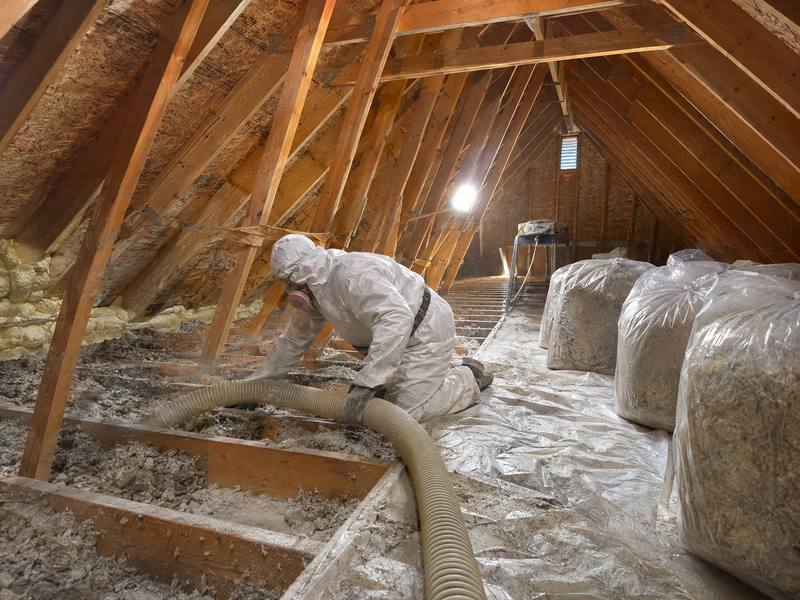
Insulation removal in Mississauga homes means taking out old, wet or rodent-damaged insulation from attics and basements, and spray foam when there is a reason for it to go. It is for homeowners dealing with a fixed roof leak, a past mouse problem or a renovation that needs the old material gone first. Asbestos abatement is a job for a licensed abatement firm, and mould goes to a mould remediation specialist.
What comes out and what can stay
Insulation that is wet, soiled or falling apart comes out, and dry insulation that is only thin can usually stay. Every removal quote we write starts with that split, made spot by spot rather than for the whole house at once.
How we decide is plain: we look, we measure and we show you. Our crew checks the depth in several joist bays with a tape measure, photographs anything wet or soiled, and walks you through which spots come out and which can stay.
Insulation that comes out
Wet insulation comes out, whether it is batts that soaked up a roof leak or blown fibreglass that matted into a crust under a dripping vent. Insulation that a rodent has nested in or soiled comes out too. Batts that have fallen from the joist bays or rotted away around an old leak go, and so does spray foam that has to go.
Insulation that can usually stay
Dry insulation that is only thin or uneven can usually stay. Blown fibreglass that has settled, or batts that leave gaps at the eaves, still work where they sit, and a top-up goes over them. Pulling out dry, clean material adds mess and cost without changing much in the house.
How removal works in a house
Removal follows the same path every time, from your front door to bare joists or bare concrete.
The last step on the list below matters most. With the space empty, you can see the top plates, the wiring, the pot light housings and the plumbing stacks, and so can we. If something needs a different trade, it shows up now rather than under fresh insulation.
- The path from the door to the attic hatch or the basement stairs is covered with drop sheets.
- A hose runs from the vacuum to the attic, and the old loose fill goes straight into bags.
- Batts and spray foam are cut and bagged by hand, so nothing loose is carried through the house.
- The attic or basement is cleaned down to the joists or the concrete.
- You see it bare before anything new goes in.
Before removal: the cause
The cause of the damage gets fixed before any insulation comes out, by the trade that handles it. Removal waits until then, because new insulation under a roof that still leaks only means a second removal later.
We point out causes like the ones listed below during the inspection, write them on the quote and wait until the right trade has finished. Then the wet or rodent-damaged insulation can come out.
- A roof leak gets fixed by a roofer.
- A bathroom fan venting into the attic gets rerouted by an electrician or an HVAC contractor.
- Mice, squirrels or raccoons are a job for a pest-control company, which deals with the animals and how they got in before we start. We do not do that part.
- Mould on the roof sheathing or the joists goes to a mould remediation specialist.
Vermiculite is not ours to remove
We do not remove vermiculite, and we do not disturb it. Vermiculite is a loose, pebbly fill, grey-brown or gold, that sits between the joists like coarse gravel. When we see vermiculite, the tape measure goes back in the pocket: our measuring stops there, the material stays exactly as it is, and nobody on our crew touches it.
Health Canada advises that some vermiculite insulation may contain asbestos and can present health risks if disturbed during maintenance, renovation or demolition. The best way to minimize the risk is to avoid disturbing it. We never sample, test, vacuum or remove it ourselves, and we do not arrange the test.
Our recommendation is that you have a qualified lab or an abatement firm test it before any work goes ahead. If removal is needed, that is a licensed abatement firm's job, not ours.
What goes back in
For an attic, the order we would choose after removal is air sealing on the bare ceiling, then new blown fibreglass. Air sealing is easiest with the old insulation gone, because the gaps around pot lights, plumbing stacks, wiring holes and the attic hatch are in plain sight instead of buried. Our crew seals those gaps, sets baffles at the eaves and then blows fibreglass up to the depth markers, the same way we handle attic top-ups.
Blown fibreglass fills around trusses and wiring without seams, which is why we would pick it for an open attic floor. Batts are the other option. They suit wide, clear joist bays with room to kneel, but every seam between them is a place for air to slip through.
In a basement, the choice is between spray foam and rigid foam board. Our spray foam insulation suits the rim joist and uneven concrete because closed-cell foam fills every gap and doubles as a vapour retarder. Foam board is tidier on a flat wall and asks for studs and drywall in front of it. We would choose spray foam for the rim joist; for the wall, it depends on how you plan to finish it, and the decision is yours.
Taking spray foam out
Our crew cuts and scrapes spray foam out when there is a reason. Spray foam removal is hand work: long blades cut the foam from the joist bays, scrapers take the rest off the wood, and every piece goes into bags.
Reasons include foam that pulled away from the framing, foam that still smells, foam blocking a rim joist or sill plate that another trade needs to repair, or a renovation that needs the cavity opened. We also remove old insulation before spray foam goes on, since loose batts behind a rim joist have to come out so the foam bonds to clean, dry wood.
Spray foam that is bonded and doing its job is best left alone. Our page on why some homeowners remove spray foam goes through when taking it out makes sense and when it does not.
FAQ
Common questions about insulation removal
Yes, old insulation should come out wherever spray foam is going, because the foam has to bond to clean, dry wood or concrete. Batts stuffed against a rim joist or between garage ceiling joists are pulled out and bagged first. Dry insulation elsewhere in the house can stay where it is.
Yes, we remove insulation that mice have nested in or soiled, once a pest-control company has dealt with the mice and how they got in. Our crew bags the damaged material and cleans the space down to the joists. You see it bare before anything new goes in.
No, we do not remove, vacuum, sample or test vermiculite. If we find it, our measuring stops, it stays exactly as it is, and we recommend you have a qualified lab or abatement firm test it before any work goes ahead. Removal, if it is needed, is a licensed abatement firm's job.
No, only the insulation that got wet or matted has to come out, once a roofer has fixed the leak. We check the wet area and the joist bays around it, then mark what goes and what stays. Dry insulation next to it can be topped up instead.
The mess stays in the attic or basement, because the path from the door to the hatch is covered and loose fill travels through a hose into bags. Batts and foam are bagged by hand before they are carried out. Our crew cleans up once the space is bare.

Get a quote
Get an insulation quote in Mississauga
Call (437) 563-1419 or send the form, and tell us what you notice in the house: a cold floor over the garage, a draft at the baseboard, a damp smell in the basement. We measure the spots that matter and give you a written quote with the options side by side.