Garage Insulation in Mississauga, ON
We insulate the garage ceiling under a bedroom or bonus room. If you plan to heat the garage, we can do the outside walls too.
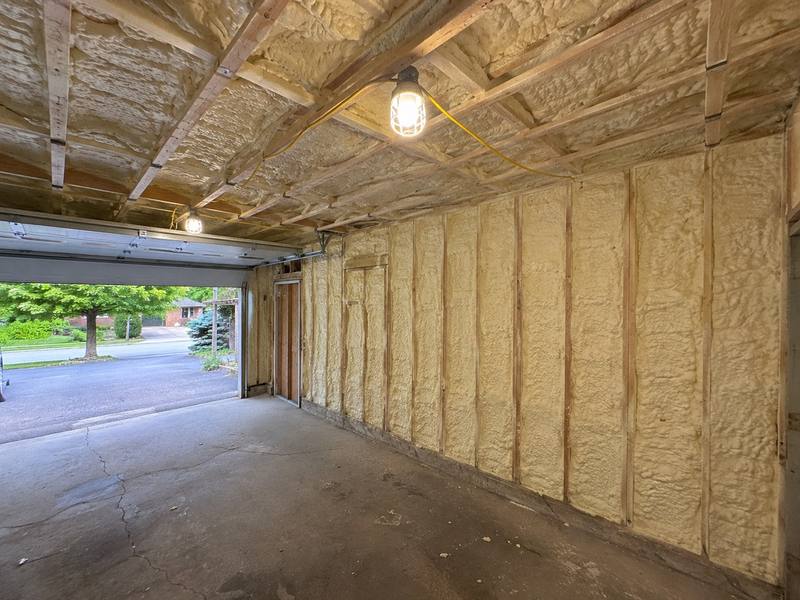
Garage insulation in Mississauga is mostly about the garage ceiling under a bedroom or bonus room, plus the outside walls if you heat the garage. We measure what is in the joist bays now, lay the options out next to each other and write up a quote. We do not work on the garage door. A garage door company looks after the door and its seals.
The ceiling under a bonus room
A bonus room floor over a garage can feel cold because the joist bays under it sit next to an unheated space, and air may move through them. Garage air can come in at the rim joist, then run along the underside of the subfloor. You can have batts in every bay and still feel cold at the baseboard if air can get around them.
Those bays can be filled a few different ways. Each one asks something different of the house.
Closed-cell foam against the underside of the floor
Our crew sprays closed-cell spray foam onto the underside of the subfloor and the inside face of the rim joist, bay by bay. It sticks to the wood, fills the cracks the air uses and acts as its own vapour retarder. Per bay, foam is the more expensive material, and the ceiling has to be open before we can spray.
Batts filling the bays
Fibreglass or mineral wool batts sit between the joists and fill the depth of the bay. They cost less to buy and to fit, and they insulate well if they sit tight to the subfloor with no gaps. What they do not do is stop air. If the real problem is a leak at the rim, the cold draft is still there after the batts go in.
Foam plus batts
First a layer of closed-cell foam goes against the subfloor and the rim joist to stop the air. Batts then fill the rest of the bay underneath. That puts the air seal where the leaks are and uses the cheaper material for the remaining depth. The ceiling still has to come open, and the price lands between the other two.
Which one we would choose for a cold bonus room floor
For a cold floor over a garage, we would pick foam plus batts. A cold floor starts at the subfloor and the rim, and that is where the foam stops the air. The batts then make up the depth for less than foam would. Shallow bays, or bays crowded with a heating duct and plumbing, can make full closed-cell foam the better fit. The written quote sets out each approach, and you make the call.
The garage ceiling is a fire separation
The garage ceiling under a bedroom or bonus room is a fire separation between the garage and the house. A finished ceiling has to be opened before anything goes in. Our crew insulates the joist bays, and whoever puts the drywall back has to bring the ceiling back to fire-separation standard. The quote says who that is. We never drill, pack or blow insulation through a closed garage ceiling, since a hole in that ceiling is a hole in the separation. If we spot a gap or opening between the garage and the house, we show it to you and leave it alone. Closing it is a fire-separation matter for a qualified contractor or the City.
Walls, if you heat the garage
In an unheated garage, wall insulation does very little. The garage sits near the outdoor temperature either way, and the room above relies on its ceiling, not the garage walls. If the garage is for cars and storage and never gets heated, our advice is to leave the walls as they are.
Once you heat the space or work in it, the walls start to count. The outside walls can take batts between the studs or closed-cell foam sprayed into the stud bays, and both need the walls open. Batts are cheaper and do fine in a wall that does not leak much air. Foam stops air at the sheathing and along the sill plate, which counts for more in a wall you plan to heat all winter.
For a heated workshop we would usually go with well-fitted batts. The exception is a wall where you can see daylight or feel a draft at the sill plate. There, foam earns its extra cost. The quote names whoever covers the walls afterwards, with drywall or some other finish.
What we leave to others
On a garage insulation job, we do the insulation and nothing else. The rest belongs to other trades, and the quote spells out who does what so no piece gets missed.
- The garage door and its seals: a garage door company looks after the door, its panels and its weatherstripping.
- Drywall, taping and paint: these go to whoever puts the drywall back on the ceiling or walls, and the quote names them.
- Gaps between the garage and the house: a gap or opening in that separation, whether around a pipe, a duct or the door into the house, is for a qualified contractor or the City. We show it to you and leave it as it was.
- Water staining in the joist bays: a plumber or a roofer fixes the source first, before any insulation goes in.
Pricing a garage
The garage insulation cost on our written quote is built from what we measure at the visit. We do not charge a flat rate per garage. Here is what moves the number:
- Ceiling area: the part of the garage ceiling under the room above, measured with a tape, not read off a floor plan.
- Foam, batts or both: closed-cell foam costs more per bay than batts, and the mix sits in between.
- A finished or open ceiling: a finished ceiling has to be opened and drywalled again, and whoever does that prices it on top of the insulation.
- What is stored in the garage: cars, shelving and boxes have to move before our crew can get at the ceiling, and the quote says who moves them.
- Heating plans: if you plan to heat the garage, the outside walls go on the quote as their own line.
- What runs through the bays: a heating duct, plumbing or wiring takes more fitting than an empty bay.
The rim joist at the garage wall
Where the floor of the house rests on the garage wall, there is a rim joist, the board that caps the ends of the floor joists. If it was left bare, or has a loose batt shoved against it, garage air comes straight into the floor bays under the room above. With the ceiling already open, our crew foams the rim joist along with the bays. It will never be easier to get at.
The same board runs around the top of a basement wall, and our page on rim joists covers that one. Still trying to work out where the cold comes from? Start with why the room over your garage is always cold, then see where it fits in our insulation work in Mississauga.
More on Garage Insulation
FAQ
Common questions about garage insulation
It depends on more than the size, and the area is only one part of the quote. The rest comes down to whether the foam goes on the ceiling alone or the walls too, whether a finished ceiling has to be opened and drywalled again, how much has to come out of the garage, and how crowded the joist bays are. We measure all of that at the visit and put it in a written quote.
Yes, if the room above has a cold floor, since the cold comes in through the garage ceiling. The joist bays between the garage and the room need insulation plus an air seal at the subfloor and the rim joist. If the room is comfortable and the floor is not cold, a newer house may not need it, and we will say so once we have measured.
No, we do not insulate garage doors. The door, its panels and its seals are a job for a garage door company. Our garage insulation in Mississauga covers the ceiling under a room above, and the outside walls if you heat the garage.
You need to clear the space under the ceiling, and along any walls we are insulating, so our crew can reach them. Cars go outside. Shelving and boxes either get moved or covered, whichever the quote says. We go over what has to move at the visit, before you book.

Get a quote
Get an insulation quote in Mississauga
Call (437) 563-1419 or send the form, and tell us what you notice in the house: a cold floor over the garage, a draft at the baseboard, a damp smell in the basement. We measure the spots that matter and give you a written quote with the options side by side.