Rim Joist Insulation in Mississauga, ON
We compare closed-cell foam, foam board and batts at the band joist, so you can weigh them before you get a written quote.
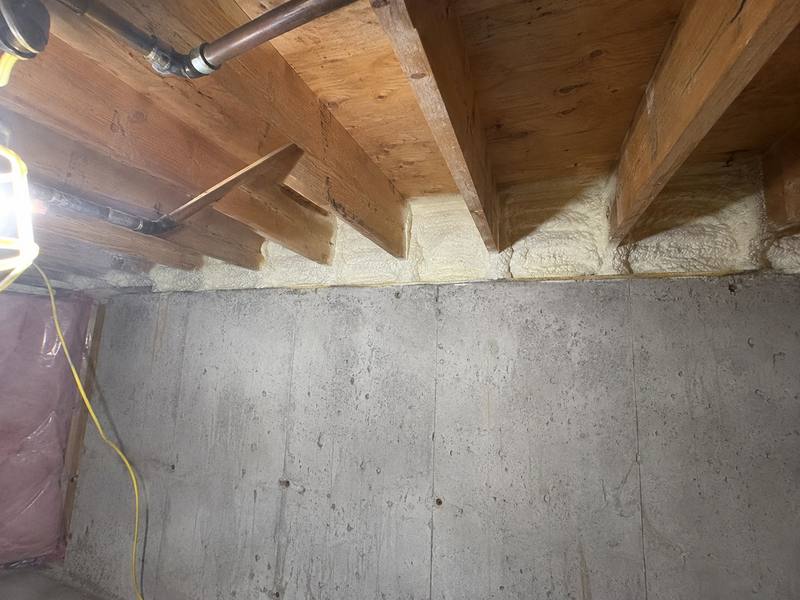
Rim joist insulation in Mississauga starts with the rim joist itself: the wooden band where the floor framing sits on top of the foundation, which may be bare and leaky. Platinum Insulation Contractors of Mississauga measures each bay, lays out the ways it can be insulated, and leaves the choice with you. This page is for homeowners with an unfinished basement, or one that is about to be finished.
Why the band joist leaks
The band joist leaks because it sits above ground, and only the sheathing and siding separate the wood from the outdoor air. The basement wall below it has soil against it. The rim joist has nothing like that.
Air gets in at two places. The first is the sill plate, which rests on the concrete, and the joint between the two is not always tight. The second is the seams where the rim boards meet the subfloor above, which can open as the wood dries and shifts. Upstairs, you may feel it as a draft at the baseboard or a cold strip of floor along an outside wall.
The floor joists divide the rim into small joist bays. Each one is a box open on one side, and some have a pipe, a wire or a duct running through. A roll of insulation never fits that shape well, so each bay gets measured and dealt with on its own.
Condensation is what to watch for. During a cold snap the rim joist can get cold enough that warm, moist indoor air condenses on it, as long as that air can reach the wood. Over time, damp wood in a dark bay can grow mould or begin to soften. Stop the air and you stop the moisture.
Three ways to do it
There are three ways to insulate a joist bay. Here they are side by side, with what each one gives you and what it asks of the house.
Closed-cell spray foam in each bay
Our crew sprays closed-cell foam directly onto the rim joist and sill plate, and it fills the seams and gaps as it builds. Because it bonds to the wood, there are no edges for air to get around. At full depth it slows vapour too. What it asks: every bay must be open and reachable, and the space along the outside walls has to be cleared before we spray. The price mostly comes down to how many bays there are and how much is in the way, like ducts, wiring and plumbing.
Foam board cut to fit, edges sealed
Rigid foam board is cut to each bay, pressed against the rim, and sealed on all four edges with canned foam or caulk. Done carefully, it works well, and it suits homeowners who would rather not have foam sprayed inside the house. What it asks is patience. The bays vary in size, pipes and wires need notches, and the sealed edge is the only thing holding back air. Miss one edge and moist air can get to the cold wood behind the board.
Fibreglass batts pushed in
Batts cost the least and do the least to stop air. Fibreglass slows heat, but air moves right through it, so moist basement air can pass the batt and condense on the cold wood behind. A batt stuffed into a bay can also hide damp wood until the damage is well along.
Which one we would choose
For this spot we would choose rim joist spray foam. The bays are small and full of gaps, and foam fills them without needing a perfect cut. Foam board is a sound second choice as long as the edges are sealed with care. We would not use batts there on their own.
You make the call. The written quote names the method you choose and the bays it covers.
When to do it
Insulate the rim joist while the bays are still open and nothing covers them.
Before the basement ceiling is finished
If basement insulation is part of a finishing project, do the rim joist first. After drywall or a drop ceiling goes up, the bays are out of sight, and reaching them means taking the ceiling down along every outside wall.
While a garage ceiling is open
When the ceiling under a bonus room is already open for garage insulation, the band joist along the outside of that space is within reach. We can insulate it in the same visit as the other joist bays there.
On its own in an unfinished basement
An unfinished basement with bare joist bays is the easiest case. The rim joist can be its own job even if you never plan to finish the space. In a newer subdivision home in Mississauga, where the attic and walls may be in decent shape, the rim joist may be the only spot in the basement worth a look. If the bays turn out to be foamed already, we will tell you the house probably does not need this job.
Covering
In a finished basement, foam at the rim joist ends up behind drywall, so the covering question is settled once the ceiling and walls are closed in. An unfinished basement needs more checking. Whether exposed foam needs a covering depends on the product's own documents and the building code, and the answer can change from one product to another.
Before work starts, we read those documents for the product we quote and tell you what they require. The longer answer is on our page that asks does spray foam need to be covered.
FAQ
Common questions about rim joist insulation
The best way to insulate rim joists is closed-cell spray foam in each joist bay, because it seals the gaps at the sill plate and the board seams as it insulates. Foam board cut to fit, with every edge sealed, is a good second choice if the work is careful. Batts alone are the weakest option here.
You can, but batts are the weakest choice for a rim joist. Air passes through fibreglass, so in winter moist indoor air can reach the cold wood behind the batt and condense there. Closed-cell foam or sealed foam board stops that air. A batt does not.
A rim joist with closed-cell spray foam at full depth usually does not need a separate vapour barrier, because the foam slows vapour on its own. Foam board sealed on every edge does much the same. The vapour barrier question mostly comes up with batts, and plastic sheeting in a small bay is hard to seal and can hold moisture against the wood. What your basement needs is set by the product's documents and the building code.
No, only the area along the outside walls needs to be clear. Our crew has to reach every joist bay and cover whatever is underneath before spraying. Please move shelving, boxes and anything stored near the rim before the visit.
Yes, once the ceiling along the outside walls is opened up. We do not insulate through a closed ceiling, since the foam or board has to sit right against the rim. The quote spells out who opens the ceiling and who closes it again.

Get a quote
Get an insulation quote in Mississauga
Call (437) 563-1419 or send the form, and tell us what you notice in the house: a cold floor over the garage, a draft at the baseboard, a damp smell in the basement. We measure the spots that matter and give you a written quote with the options side by side.